See who's really behind the contract.
CifraPulse resolves messy award records into canonical entities and connects buyer → incumbent → parent → subsidiary → exposure → sanctions screening in one view. The company that was awarded often isn't the obvious name.
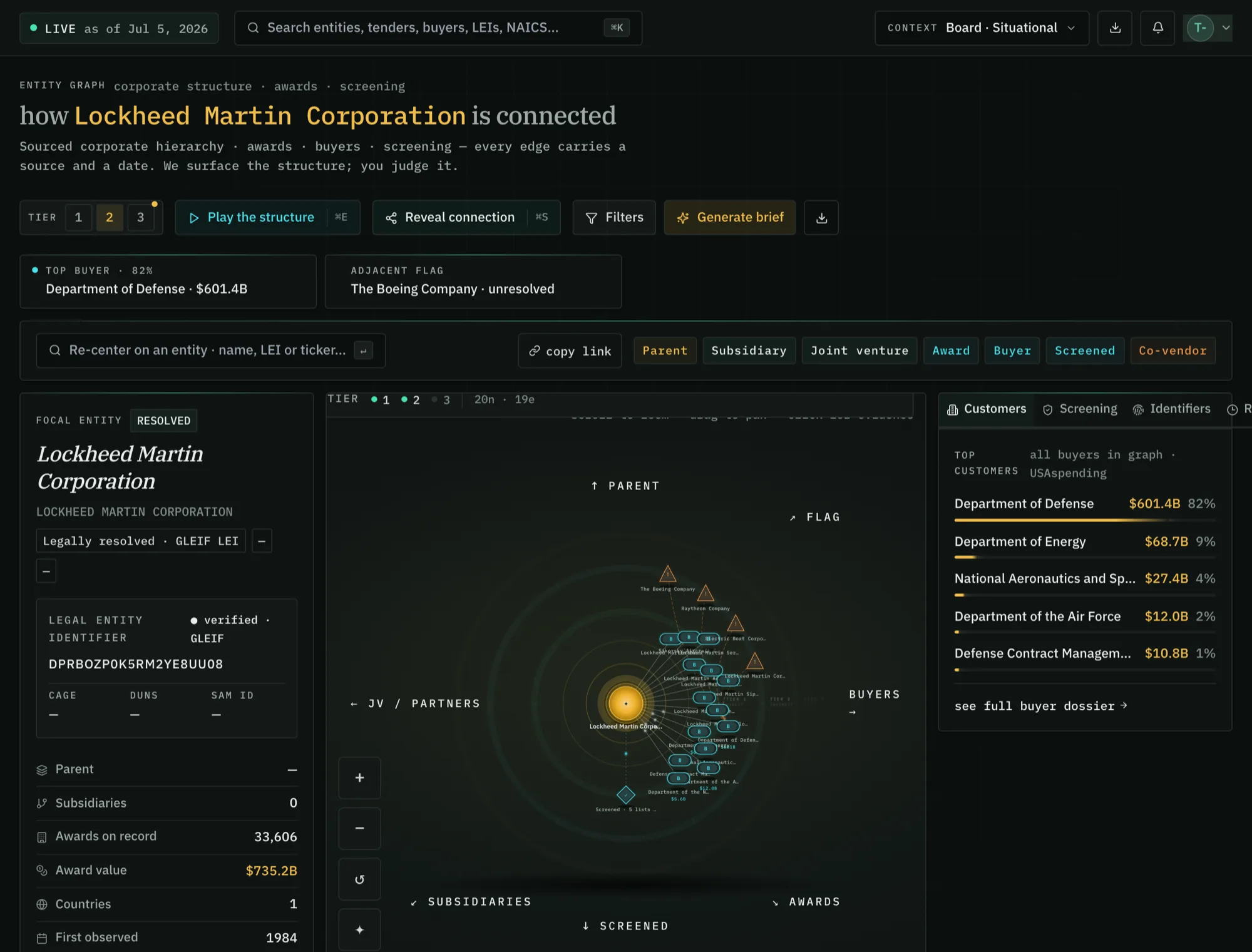
Records become a resolved graph.
Four factual layers, each sourced and dated. No synthesized verdicts — the readout carries the facts and lets you conclude.
Entity resolution
“Lockheed Corp,” “Lockheed Martin Corporation,” and “Sikorsky” roll up to one canonical parent. The supplier string on the award is rarely the company that actually holds it — resolution makes the real entity visible.
The connected correlation web
Each entity is linked to its awards, the open opportunities in its sectors, and the recompetes with recorded period ends ahead — one connected view instead of four disconnected searches.
Per-entity intelligence
Real awards with concentration and exposure, plus identifiers shown honestly: GLEIF LEI and SEC ticker as resolved where matched and pending where not — never a fabricated ID.
Sanctions & debarment screening
Each entity is screened against OFAC, UN, and EU official lists. A clean screen reads “screened · no name-based match” — a fact, with its source and date — not a clearance verdict.
Four states — the strength of every match is on the record.
Each entity, identifier, and screening result reads as one of four factual states — the same glyph and colour it carries on the node in the graph, never a fabricated certainty.
Which buyers an entity's award value on record sits with, and how concentrated that exposure is — a single-buyer share read straight from the record, not a risk score.
The span of years an entity appears in the award record, buyer by buyer — how long a relationship has held on file, stated as a fact, never a stability rating.
When exposure, continuity, and independent identifiers line up on the same entity, that agreement is what carries weight. Any one record is dismissible; their convergence is harder to ignore.
Others return flat records. We connect them.
Competitors give you better search over the same disconnected rows. CifraPulse resolves those rows into one graph across US and multilateral buyers — every figure sourced and dated, and the strength of each match shown plainly.
- Resolved, not just searched. Buyer → incumbent → parent → subsidiary, connected — not a flat result list.
- Across US + multilateral. USAspending and World Bank entities in the same graph, not siloed by source.
- Resolution state named. e.g. “source-linked · LEI unresolved · resolution expanding” — the state is visible, never a score.
How official records line up.
A descriptive method, not a forecast. Each stage is a separate official record; where independent records agree across the stages, the picture describes conditions consistent with changing activity — never a prediction, score, or verdict.
- 1Pressure
A published need, deadline, or mandate appears in the official record.
- 2Intent
A budget line or planning notice signals an intent to act.
- 3Funding
An appropriation or development-bank approval authorizes the spend.
- 4Opportunity
A solicitation or tender notice opens the requirement to the market.
- 5Award
A contract award names the entity that holds the work, with value and date.
- 6Delivery
Performance records, modifications, and completions mark how it resolves.
- 7Consequence
A period-of-performance end date or follow-on sets up the next cycle.
Pressure → Intent → Funding → Opportunity → Award → Delivery → Consequence. CifraPulse surfaces the official traces at each stage and where they converge — it does not forecast outcomes, assign probabilities, or recommend action.
One graph, three jobs.
Analysts
Parent-level exposure and concentration nobody else connects — see the whole corporate tree behind a flow of awards.
Business development
The real incumbent behind a recompete — the entity actually holding the contract, not the name printed on the line item.
Compliance
Sanctions and debarment screening built in — OFAC, UN, and EU checked per entity, each result sourced and dated.
This is an informational intelligence view. Verify entity and eligibility details with the contracting authority.
See who's really behind it.
Sign up free to explore the Entity Graph — resolved entities, connected awards, screening, all sourced and dated.